It is a weird situation. Apple products are consumer products but they make us use them as development hardware because there is no other way to make software for those products.
Metal has the marvelous quality of showing up well on X-ray, and clothing has the marvelous quality of never getting cancer from X-rays.
Pieces of cotton do not show up on X-ray, and humans do get cancer from too much ionizing radiation.
Of course miscounts happen sometimes, and sometimes both the initial and final counts are one short of the true number, but the vast majority of undetected retained items are sponges made of cotton. Not tools, not even tiny needles. That’s why there is a radiopaque strip embedded in the sponges intended for use during surgery.
Because there's no practical way to do it on the scale of an entire factory. It works for surgery because you only do a single surgery in a single room on a single person with a countable number of supplies.
Clothing doesn't get cancer. Also a lot of what can get left in a patient doesn't show up super well on x-rays, so more general solutions like counting in and out are preferable.
The overall amount of helium in the atmosphere is still more than enough for the foreseeable future, and it could be extracted (albeit at high energy cost) by augmenting existing air separation units (ASU's). Of course natural gas wells currently provide an easier to extract source, seeing as the concentration there is way higher.
Helium is only 5ppm in the atmosphere. Extracting useful quantities of it that way will probably never be economically viable. In other words, if for some reason we can no longer get helium from natural gas wells then it will be cheaper to just let patients die instead of doing cryogenic distillation of helium from the atmosphere to run MRI machines.
MRI could switch to LH2. Yes, it's explosive and higher boiling temperature so would not support as high field and incompatible with currently used semiconductors. But it's doable. Plenty of other important uses (i. e. semiconductors and lasers) where it is much more irreplaceable.
We are already separating out the majority elements from air via ASU plants, so we should compare the abundance of helium in what is left from typical extraction. And that looks quite technically viable, if obviously uneconomic at present.
Oxygen, nitrogen, CO2 and argon make up 99.94% of the atmosphere. The remaining 0.06% has 5ppm is nearly 1% helium. That's up 200x from the original concentration and is well above the 0.3% that is sometimes quoted as the limit for economic extraction of helium (and well below the 7% of some natural gas).
Furthermore, the leftover gas is also already cold. It is absolutely true that 85K isn't very close to the boiling point of helium, it is a lot closer than starting at the temperature of gas at the well head.
The gotcha is almost certainly going to be that an ASU probably doesn't liquify most of the gas it takes in. That means that the exhaust gas will only be slightly enhanced.
In a world of extremely cheap solar electricity pushing grid prices negative, a lot of things might be a lot more economical then conventionally thought though - particularly when you factor in the desire to get a full return on industrial manufacturing of panels.
For me personally, this is one of the most promising aspects of solar that I hope to see in the future. There are many, many things we could do but currently do not because the energy cost is not worth it. Push the energy cost to zero, or even below, and it will be interesting to see what new things become abundant.
CO2 capture from the atmosphere, turning it into hydrocarbons. All the solar panels/wind farms combined have quite large surface that might be useful for the capture. Just need to figure out the mechanism to do it. Easy-peasy, right? :-)
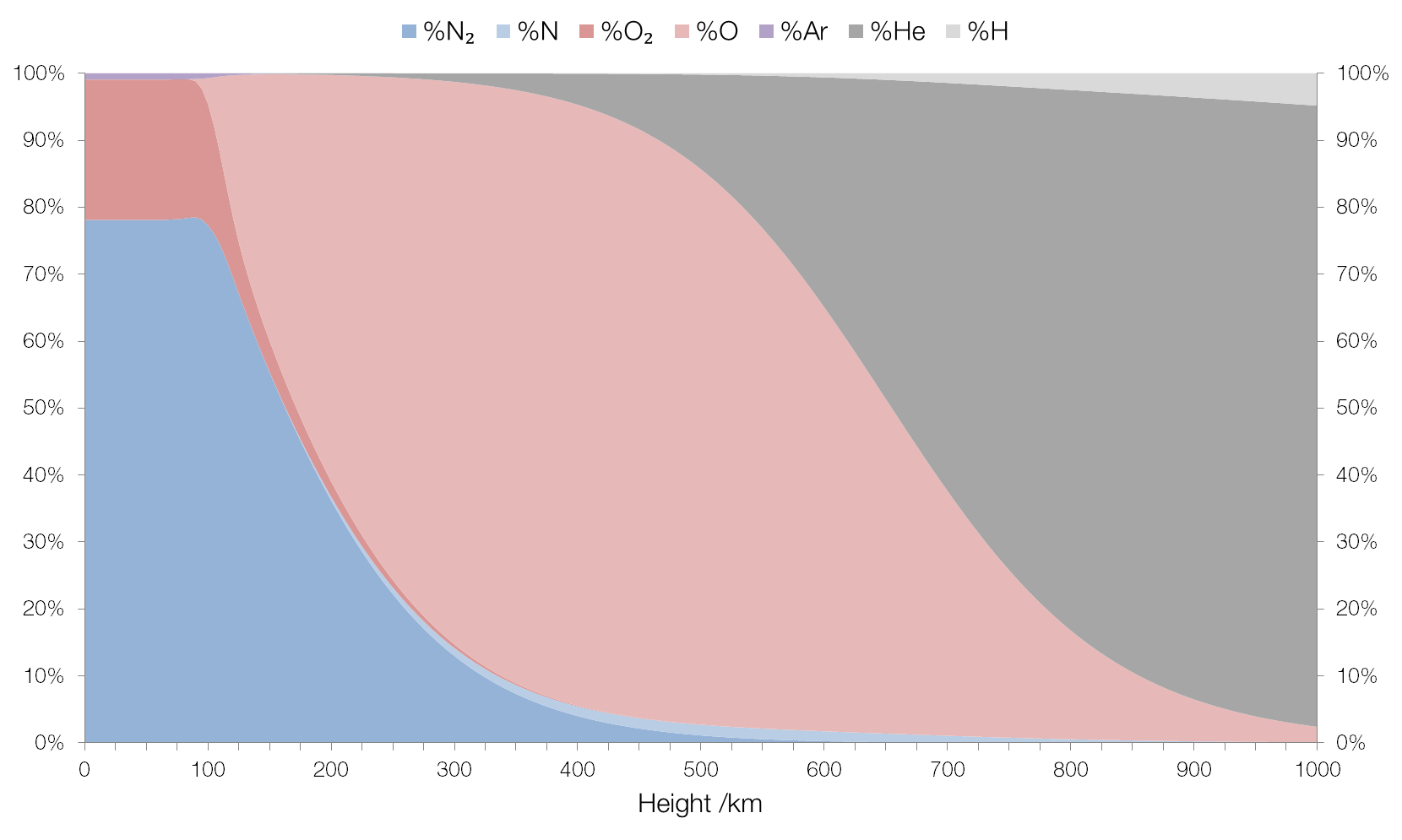
observe that where Helium becomes a significant percentage, there is also Hydrogen and (monoatomic) Oxygen.
if one were driven by purism or vanity for stoichiometric exactness, then at a height of 1000 km theres 2 Hydrogens per Oxygen atom, so this could be reacted to water, and the energy used to power compression of the Helium, the water would freeze.
without this vanity, helium becomes a significant fraction at much lower heights... and thus higher densities.
The energy to compress becomes nearly insignificant at low pressures.
if humanity ever builds space elevators, this will be one of many benefits of having space elevators.
I'd believe it. Wikipedia has a similar one [1] but it shows a bit more hydrogen than helium at higher elevation.
Awesome graph! Worth stating that the increase in the relative fraction of He isn't so much because there's a lot of He out there as because there's a lot less of everything else. Overall density falls off roughly exponentially but lighter elements have a longer tail.
So once you get out to a few earth radii quite a bit of what you see might be ionized helium but that doesn't mean you can do much with it.
If by “free” you mean “very very expensive” then i agree with you. It would cost a fortune to even just attempt a pilot project proving feasability. Then we would need to send up regular replacements to the “sending the harvest down” hardware at the minimum. Just imagining the cost of a tank which can be launched into space, autonomously dock with the collector sails, then deorbit and land makes my head spin. And then doing that at scale, paying people to launch it, paying people to operate the system.
It could be free if we imagine some crazy advances in autonomous self-replicating spacecrafts. But by then we live in the post-scarcity diamond age probably.
I meant some semi permanent harvesters (which would cost a fortune to build and deploy).
Sending the harvest down could maybe happen inside plastic containers built in place, made with the abundant sunlight, some Co2 and water (not sure if there's CO2 this high though. In retrospect we'd need also some metals to print some sort of the antenna reflecting radar frequencies (for the ground stations tracking them on the approach)?
And with the hundreds of small containers (carefully balanced so they don't smash in the ground but slowly rain onto the area) maybe it'd be easier.
I don't know. I think it's hard sci-fi, achievable within our lifetimes :)
That could be possible for browser apps which already have a sandbox. Doubtful for general purpose languages. For example I have a library and utility to change user password, or writing sudo alternative sudors etc. How would you even begin to sandbox that are core os utilities or need access to core os themselves.
more specifically, one can introduce policies into the runtime, or given rust hoist at least some of them into compiletime that would do things like (a) enforce syscall filtering based on crate or even function (b) support private memory regions for crates or finer grained entities that are only unlocked upon traversing a declared call-gate (c) the converse, where crates can only access memory they themselves have allocated except a whitelist of parameters (d) use even heavier calling conventions that rpc to entirely separate processes
By using the type system. You define your type constraints at the module interface point and when you try to link the third-party module into that interface the compiler ensures that the constraints are satisfied. Same thing the compiler is already doing in simpler cases. If you specify that a third-party library function must return an integer, the compiler will ensure that function won't unexpectedly return a string. Just like that, except the type system is expanded to enable describing more complex behaviours.
Git is still pretty lacking in the area of big files. This is quite annoying if you're dealing with big deep learning data. So your LEGO vacuum robot could actually benefit from a better Git.



reply